The Next-Generation BCI Ecosystem

From raw signal to

Run your entire BCI workflow in one desktop app, then publish methods others can actually reproduce.

Reproducible
AI-Powered
Collaborative
Publication-Ready

Built for biosignals

EEG, fNIRS, and EMG in one workspace.

Pipelines, not scripts

Design the method once, reuse it anywhere.

Runs on your machine

Your data and compute stay local by default.

Method travels with results

Workflow, settings, and reports stay attached.

Two apps, one workflow

Run it in BCILattice. Share it through BCINexus.

Do the work locally, then publish the method, no scripts to stitch between the two.

Desktop app · Free

BCILattice

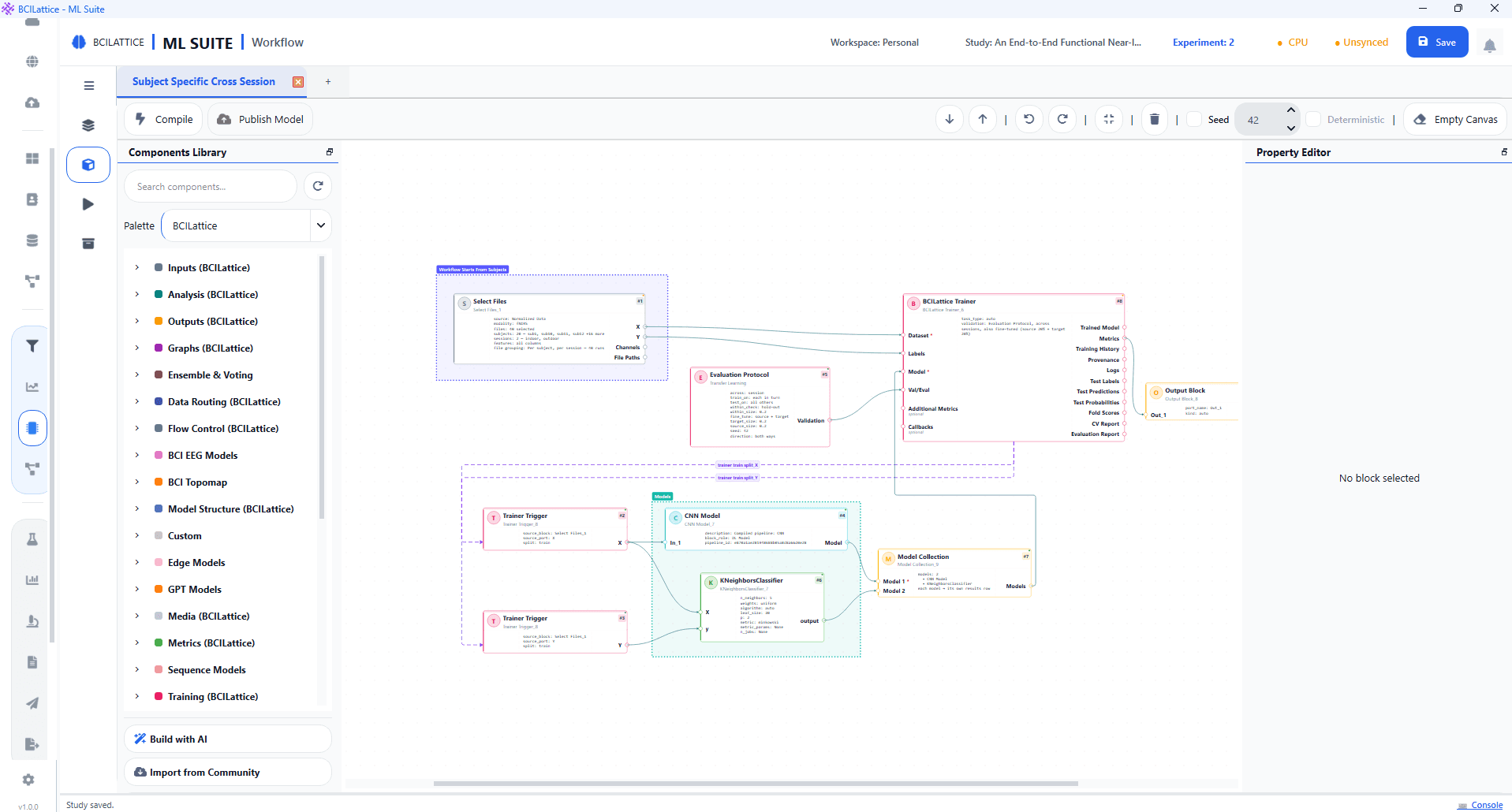
The desktop workspace you actually work in.

Signals

Import files or stream live EEG, fNIRS, EMG.

Analysis

ICA, epoching, time-frequency, and features.

Training

Visual pipelines with local CPU/GPU training.

Reports

Publication-ready figures and exports.

Cloud platform

BCINexus

Where the work gets shared and reused.

Workflows

Reusable, versioned pipelines.

Review

Team feedback and reviewer sign-off.

Publish

Methods and results others can rerun.

Community

Discover, cite, and reuse work.

One account works across both apps.

Analyze locally Publish globally Reuse methods
What you can do

Everything from raw signal to published method.

Acquire, preprocess, build pipelines, train models, and publish without stitching scripts together.

Free desktop app

BCILattice

One app. Your entire BCI workspace.

Real analysis, not scripts

Channel quality and visualizations, ready before you train.

One format, every stage

Same project from raw signal to shared study.

Built for teams

Share workspaces, compare runs together.

BCILattice, Analysis
BCILattice Analysis workspace showing channel scores and a visualization chart
How it works

From local workflow to reproducible publication

Start in BCILattice, package the method with its artifacts, then publish only when the work is ready for others to inspect and reuse.

Reproducible workflow path7 steps
STEP 01

Download BCILattice

Run work locally

STEP 02

Load your data

EEG, fNIRS, EMG

STEP 03

Reuse a study

Import published work

STEP 04

Build the method

NeuralFlow and MLFlow

STEP 05

Train and report

Keep compute local

STEP 06

Publish context

Share artifacts

STEP 07

Review and cite

Feedback, link, reuse

live
Faster experimentation

One workflow.
Every subject and model, compared.

Build one pipeline, compare models, track every run.

Multi-subject pipelines in one workflow
Model Selector compares architectures
Every run logged and restorable in Experiment Hub
Model comparison training

5 models × subjects · logged in Experiment Hub

S1S2S3S4S5S6S7S8S9EEGNetShallowCDeepConvLSTMTransf.
36/45

Multi

subjects

Side by side

model results

1 workflow

drives it all

HOW PUBLISHING WORKS

From workflow to reusable research.

01

Prepare & Describe

WORKFLOWMETADATA
BCILattice
100%research packaged

Every workflow is complete and reproducible.

WHAT YOU PREPARE:

Complete your workflow in BCILattice, including preprocessing, training, evaluation, reports, models, and generated artifacts.

WHAT YOU DESCRIBE:

Add the title, abstract, methodology, datasets, authors, references, and supporting documents.

READY FOR PUBLICATION:

Your research is organized into a complete submission instead of disconnected files.

02

Review & Share

VISIBILITYREVIEW
BCINexus
3visibility levels

Private, shared, or public, your choice.

VISIBILITY OPTIONS:

Keep your work private, share it with collaborators, or submit it for public publication.

QUALITY REVIEW:

Reviewers evaluate completeness, reproducibility, documentation, and overall research quality.

PUBLICATION READY:

Only approved research moves forward to public release.

03

Publish & Build Upon

PUBLICATIONLINEAGE
BCINexus
reusable research

Every publish creates a reusable research asset.

WHAT GETS PUBLISHED:

Workflow, datasets, artifacts, reports, citations, downloads, version history, and supporting documentation.

COMMUNITY IMPACT:

Researchers can reproduce, extend, benchmark, fork, and cite your work while preserving complete research lineage.

Reusable studies

Stop starting from zero.
Reuse studies that already run.

Explore published studies. Adapt proven methods. Publish reproducible research.

¬‚¦

Published studies

9+

Paradigm types

5+

Paradigm categories

Free

to browse and import

BCINexus Community

Build credibility with
researchers solving similar problems.

Connect with researchers, learn from proven approaches, and publish work that others can reproduce with confidence.

EEG ResearchersfNIRS LabsBCI EngineersClinical TeamsPhD StudentsPostdocs
View full leaderboard
Our Mission

Make BCI research connected, reproducible, and ready to build on.

Brain-computer interface research is spread across datasets, scripts, models, laboratories, papers, and private workflows. BCINexus brings these pieces together into one research ecosystem where people can discover, build, share, review, and reuse BCI work.

Research should not stop at publication. A result should carry enough context to understand where it came from, how it was produced, and whether it can be trusted. BCINexus connects data, methods, models, workflows, studies, and people so researchers can move from finding an idea to building on it without reconstructing the entire experiment.

  • Open by defaultFree tools and an open research commons for researchers, students, labs, and institutions.
  • Everything connectedDatasets, preprocessing, paradigms, models, workflows, studies, and researchers in one ecosystem.
  • Compute stays yoursAnalyze recordings locally. Your data remains on your machine until you choose to share or publish it.
  • Research that can be trustedResults retain their context — sample size, baselines, uncertainty, methods, and source reports — so others can understand and reproduce the work.
  • Built to move research forwardFrom experiment to workflow, from workflow to publication, and from publication to the next study.
Across Research Labs Education Startups

BCINexus

The research infrastructure for BCI.

ResearchersWorkflowsModelsDatasetsStudiesPeer ReviewLabsInstitutionsDeploymentEdge Devices
Questions, answered

How BCINexus fits into your research

No. BCINexus complements publishing platforms such as IEEE, Springer Nature, Elsevier, Frontiers, and PLOS, as well as neuroscience journals like the Journal of Neural Engineering. Your paper is published through your chosen venue, while BCINexus hosts the complete research workflow, datasets, code, studies, models, and documentation, making your work reproducible, reusable, and easy to cite.

Still have a question? Talk to the team

Start with your data

Get BCILattice free today.
Publish research others can reproduce.

From raw signals to published research in one workflow.

Local-first Visual workflows Reusable studies Research publishing